
What Is Plytix AI Content Studio?
By the Plytix Team · Updated May 14, 2026
TL;DR
- Plytix AI Content Studio is a set of AI-powered content and image tools built into Plytix, so teams can write, translate, improve, and optimize product content where the product work already happens.
- If you manage lots of products, channels, markets, or languages, AI product content automation can reduce the manual work of writing, translating, editing, and preparing product content at scale.
- Most AI tools generate content via prompts (ChatGPT/Claude/Gemini), but require manual data input, lack catalog context, and need copy-paste back into your systems.
- Plytix AI Content Studio stands out because it uses the product data, images, attributes, and brand context already in Plytix to help teams create better product content faster, with less manual work and fewer disconnected tools.
Plytix AI Content Studio: Jobs to be Done
| Capability | Other AI Tools (ChatGPT / Claude / Gemini) | Plytix AI Content Studio |
|---|---|---|
| Catalog awareness & learning | Requires product data to be provided manually in each prompt | Works from your real product catalog and existing content, using your attributes and product context inside Plytix |
| Tone of voice | Generates generic content unless tone is manually described in prompts | Adapts to your brand's existing voice; writes copy that sounds like you, not generic AI (AI for Product Listings) |
| Bulk content generation | Generates content one prompt at a time | Generates and transforms content across many SKUs at once, directly inside Plytix workflows |
| Channel optimization | Can generate channel content, but often copy and pasted into channel manually | Adapts content automatically to channel rules and character limits |
| Translation at scale | Can translate text, but separate from your catalog | Translates content at scale directly within your catalog workflow |
| Image editing | Can edit images, but separate from your DAM/workflow | Background removal, AI upscaling, and turning basic pack shots into staged product images, all inside your DAM |
| Content accuracy | Accuracy depends entirely on data provided in prompts | Uses your product attributes as the source of truth; no hallucinated details |
| Workflow integration | Separate tool; content must be added back to catalog manually | Updates product data directly inside Plytix PIM with AI features; no copy-paste required |
What is an AI Tool and why you may need one?
An AI content tool is software that can help automate tasks like writing, translating, optimizing, or editing product content and images.
For ecommerce teams, using AI for product content can significantly reduce the manual effort required to manage product content at scale. You probably need an AI tool if:
- You are expanding to new regions and need to translate thousands of titles, descriptions or features into local languages.
- You need to generate unique, SEO-friendly descriptions for marketplaces like Amazon, eBay, or Shopify.
- You need to adapt product content for different channel rules, character limits, or formatting requirements.
- You have product photos that need better lighting, cleaner backgrounds, higher resolution, or channel-ready formatting.
- Your team spends too much time copying product data between spreadsheets, AI tools, DAMs, ecommerce platforms, and marketplaces.
As your product catalog grows, it becomes incredibly time-consuming for your team to manually write, optimize, and translate every single SKU. AI tools can handle much of the repetitive heavy lifting so your team can focus on product quality, channel performance, and growth.
What most AI tools offer
AI tools like ChatGPT, Claude, and Gemini have revolutionized the way we work. They can help with:
- Generating written content
- Summarizing or analyzing information
- Translating and cleaning text
- Editing images
- Assisting with repetitive workflows
However, these tools usually operate outside your product systems. To use them for ecommerce, teams often need to copy product data into the AI tool, write prompts, download or copy the result, check the output, and paste it back into the right place.
That workflow can still be useful, but it creates extra steps. It also increases the risk that content gets disconnected from the product data it came from.
General AI tools may remember parts of your brand or preferences over time, but they are not directly connected to your product catalog, DAM, attributes, channel requirements, or publishing workflows. That means your team still needs to manually provide the product context required to get results that are accurate, relevant, and ready to use.
What Plytix AI Content Studio does differently
Plytix AI Content Studio runs inside the platform and updates product data directly, while general-purpose AI tools like ChatGPT, Claude, and Gemini work outside your product systems.
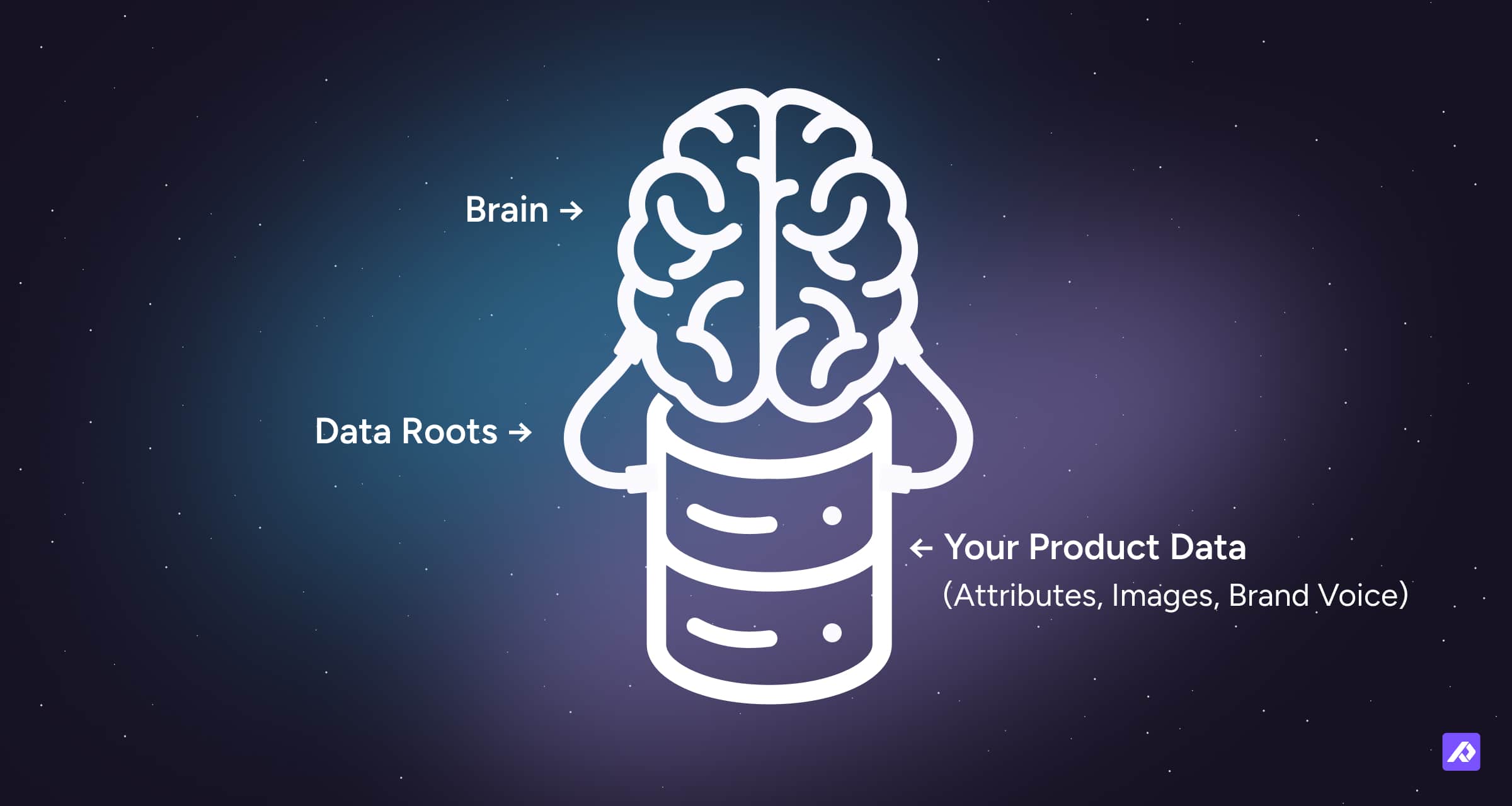
Plytix AI Content Studio is a set of AI-powered content and image tools built into the places where product work already happens, including your PIM, DAM, automations, and channel workflows.
That means that it can work from the products and content already in your account. It can use your attributes, existing descriptions, images, and product context to generate more relevant content.
For example, if your product is made of 100% organic cotton, the AI can reference that attribute when creating content. It does not need your team to manually paste that detail into a separate prompt every time. It can work from the product information already stored in Plytix.
That matters because ecommerce content is not just creative writing. It needs to be accurate, structured, consistent, and adapted to the places where you sell.
The real power of Plytix AI Content Studio is that it doesn’t require a new tab. It lives exactly where your products, images, and team live:
- No more copy-paste: You do not have to jump between your PIM, ChatGPT, spreadsheets, and ecommerce tools. AI content work can happen directly inside Plytix.
- One single source of truth: Your team can use product attributes, descriptions, images, and brand context from one central place.
- Review before publishing: When AI helps enrich content, your team can review it, edit it, and keep it connected to the right product record before publishing or distributing it.
- A practical collaboration space: Humans and AI work together directly inside the product catalog, making it easier to scale product content without losing quality, accuracy, or brand consistency.
Plytix AI-powered media enhancements
Plytix AI Content Studio doesn’t stop at written content. Because it’s connected to your DAM, it can also work on your media files. Typical use cases include:
- Removing or replacing image backgrounds to meet retailer requirements
- Relighting product images to better match brand guidelines
- AI upscaling to improve resolution and image quality
- Turning a basic pack shot into a more engaging staged product image
- Preparing images for channel-specific requirements, including aspect ratio, format, size, and file weight
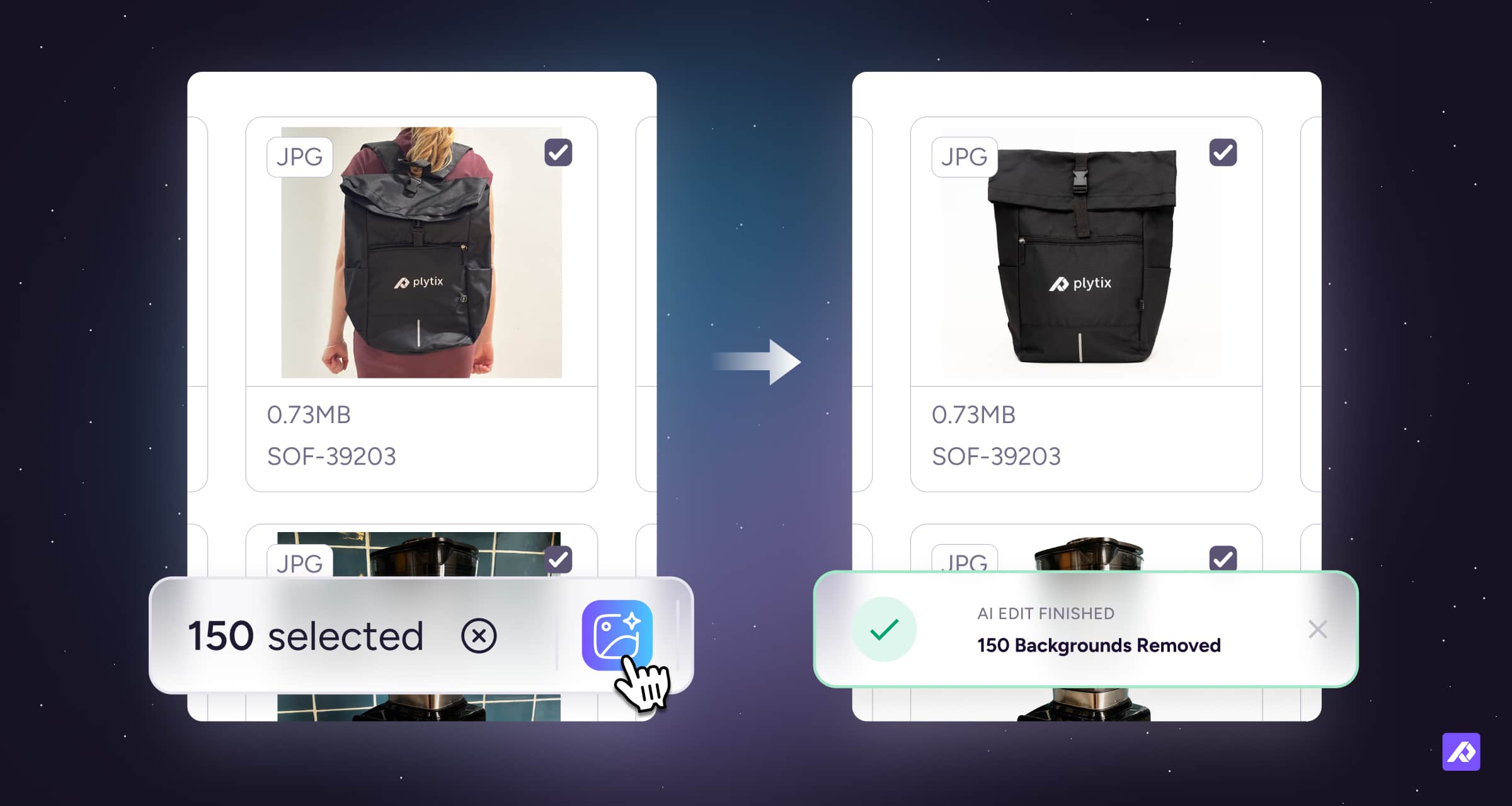
This is especially useful when product images are almost ready, but not quite channel-ready. Maybe the lighting is inconsistent. Maybe the image is too small. Maybe the background does not meet retailer requirements. Or maybe the image format does not match what a specific ecommerce channel expects.
Instead of editing every file one by one in a separate tool, teams can improve selected assets in bulk while keeping the work connected to the right products.
AI-edited images can be created as new assets, so teams can review the results before replacing or publishing anything. The original image stays intact, and teams can decide when and where to use the edited version.
Is Plytix the right fit for you?
Plytix AI Content Studio is a strong fit for ecommerce teams that want to improve product content without adding more disconnected tools to their workflow.
It is especially useful for:
- High-volume retailers: If you need to generate, translate, or improve content across hundreds or thousands of SKUs.
- Multi-channel sellers: If you need different product content for Shopify, Amazon, Google Shopping, marketplaces, retailers, or regional storefronts.
- Distributors and wholesalers: If you receive inconsistent data from suppliers and need to normalize product content into one consistent structure and voice.
- Teams expanding internationally: If you need to translate and localize product content while keeping product facts and brand voice consistent.
- Teams with lots of product images: If you need to improve image quality, clean backgrounds, adjust lighting, or prepare visuals for different channel requirements.
Plytix works best when AI is part of a structured product content workflow. The goal is not just to generate more content. The goal is to generate better product content from better product data.
Frequently Asked Questions
Each base plan comes with a number of monthly AI credits to help you get started. If your team needs more, you can purchase additional credits based on your usage.
Plytix AI Content Studio is built into Plytix rather than managed as a separate tool. Its AI features appear where product content work already happens, such as product records, attributes, assets, automations, and channel workflows.
That means teams can use AI without exporting product data, editing it somewhere else, and importing it back into the catalog.
Yes. By referencing variant attributes such as color, size, material, or other product details, Plytix AI Content Studio can help generate unique descriptions for SKUs in a product hierarchy.
Yes. You can include “Blocked Terms” in your prompts to ensure the AI never uses certain words that are off-brand or restricted by specific marketplaces.
Yes. Plytix AI Content Studio can help teams create product content that follows existing brand context, tone of voice, and product information. This is especially useful when generating or translating content across many products, markets, or sales channels.
Plytix AI Content Studio is specifically built for ecommerce and works directly with your product catalog and DAM. Unlike general-purpose AI tools, Plytix is the best AI solution for product content by automatically using your real product attributes, learning your brand voice, and generating, optimizing, and translating content at scale. All without leaving your catalog.
Yes. Plytix AI Content Studio can help teams improve product images with AI-powered media enhancements inside Plytix DAM. Teams can use AI to remove or replace backgrounds, adjust lighting, upscale images, and prepare product visuals for channel requirements like aspect ratio, format, size, and file weight.
AI-edited images can also be created as new assets, so your team can review the results before deciding where to use them.