
What Is Product Information Management (PIM)?
Product Information Management, or PIM, is the process and software used to centralize, enrich, and distribute product information so teams can turn product content into a growth asset across channels. Most companies think PIM is about organizing product data. In practice, it is about making product information work harder across ecommerce, marketplaces, retail, and internal teams.
For example, imagine a brand selling the same catalog through Shopify, Amazon, and wholesale. Without PIM, each channel often ends up with different titles, missing attributes, outdated images, or last-minute spreadsheet fixes. With PIM, that brand manages product content from one source and adapts it for each destination without rebuilding everything every time.
That is why PIM matters. It does not just keep product information organized. It helps teams launch faster, sell more consistently, and expand without multiplying manual work.
By the Plytix Team · Updated May 14, 2026
TL;DR
- PIM stands for Product Information Management.
- PIM refers to both the process of managing product information and, more commonly, the software used to do it.
- A PIM system helps teams centralize, organize, enrich, and distribute product content across channels.
- Companies usually need PIM when spreadsheets stop scaling or when they start selling across multiple channels, markets, or product lines.
- The biggest misconception is that PIM is just storage. In reality, it is the operational layer that makes product content perform.
- A simple way to understand PIM is this: Import → Organize → Enrich → Distribute → Optimize.
- The strategic value of PIM is that it helps product content drive revenue, speed, and channel expansion.
What is Product Information Management (PIM)?
Product Information Management is the discipline of organizing and managing all the information needed to market and sell products.
That includes raw product data like dimensions, materials, SKUs, ingredients, certifications, and compatibility details. It also includes customer-facing content like titles, descriptions, bullet points, images, videos, translations, and channel-specific attributes.
In practice, most people use the term “PIM” to mean the software that manages all of this.
A PIM system gives businesses one place to store, structure, enrich, and share product information so teams are not forced to work across spreadsheets, supplier files, ecommerce backends, and shared drives at the same time.
Why product content matters more than most teams think
Product content affects much more than product organization. It affects how fast you launch, how well you convert, how clearly customers understand what they are buying, and how easily you can expand into new channels or markets.
When product content is incomplete, inconsistent, or hard to adapt, the business feels it in real ways:
- launches take longer
- channel listings are weaker
- teams repeat manual work
- customers get less clarity before purchase
- expansion creates more operational drag
When product content is structured and ready to use, the opposite happens:
Faster launches
Teams can move from raw product data to live listings much faster because the content is already organized, enriched, and channel-ready.
Better conversion
Shoppers see richer, clearer, more accurate product information, which improves trust and helps them buy with confidence.
Lower returns
When product details, dimensions, compatibility notes, and images are more accurate, expectations are clearer before purchase.
Easier channel expansion
Teams can adapt product content for Shopify, Amazon, retail partners, catalogs, marketplaces, and new markets without starting from scratch each time.
That is the strategic case for PIM. It does not just help manage product content. It helps product content contribute to growth.
Product Information Management: process vs software
Product Information Management technically refers to the process of managing product data. In everyday business language, though, PIM usually means the software that supports that process.
| Term | What it means |
|---|---|
| PIM process | The discipline of organizing, enriching, maintaining, and distributing product information |
| PIM software | The platform that helps teams do that work at scale |
Throughout this page, when we say “PIM,” we are mainly referring to PIM software.
What is a PIM system?
A PIM system is the software used to centralize and manage product information in one place.
It pulls together product data from multiple sources, gives teams a place to improve and structure it, and then sends finished product content to the channels and teams that need it.
A simple way to think about it is this:
- your ERP may know the product exists
- your DAM may store the media files
- your ecommerce platform may display the product
- your PIM is where the product content becomes complete, consistent, and ready to launch
How does PIM compare to similar tools?
If you are researching PIM software, you have probably also come across spreadsheets, DAM, ERP, MDM, PXM, and feed tools.
Here is the short version:
| Tool | What it does | Where PIM is different |
|---|---|---|
| Spreadsheets | Flexible and familiar for small setups | They break down under channel, variant, and collaboration complexity |
| DAM | Manages digital files and media assets | PIM manages the broader product content structure around those assets |
| ERP | Manages operational business data like inventory, orders, and purchasing | PIM focuses on product information for commerce and marketing |
| MDM | Governs master data across the business | PIM is narrower and more practical for product content workflows |
| Feed management tools | Format and distribute product data to channels | They still rely on clean, structured product information from somewhere else |
| PXM | Focuses on product experience and optimization | PIM is usually the foundation underneath that work |
PIM is the system specifically designed to manage the product information layer needed to sell across channels.
What does PIM software do?
A PIM helps teams:
- centralize product information in one system
- structure products, variants, and attributes clearly
- enrich listings with copy, specs, assets, and translations
- keep channels aligned with current, accurate content
- distribute product content in the right format for each destination
In short, PIM turns scattered product data into content that can launch, syndicate, and scale.
How does PIM software work?
At a high level, PIM works by taking raw or fragmented product information and turning it into structured, publishable product content.
| Step | What happens in a PIM | Why it matters |
|---|---|---|
| Import | Product data enters from ERPs, supplier files, spreadsheets, PLMs, APIs, or other upstream sources | Brings scattered product information into one system |
| Organize | Products are structured into categories, families, variants, and attributes | Creates consistency and makes information easier to manage |
| Enrich | Teams add copy, images, specs, translations, documents, and channel-specific content | Turns raw product data into market-ready product content |
| Distribute | Product information is pushed to ecommerce platforms, marketplaces, catalogs, feeds, retailers, or internal teams | Gets the right content to the right destination |
| Optimize | Teams improve completeness, accuracy, and channel adaptations over time | Improves performance across channels |
That workflow is what makes PIM valuable. It gives teams a repeatable way to move from messy inputs to publishable outputs.
How do you know if you need a PIM?
You usually need a PIM when product information stops being easy to manage and starts slowing the business down.
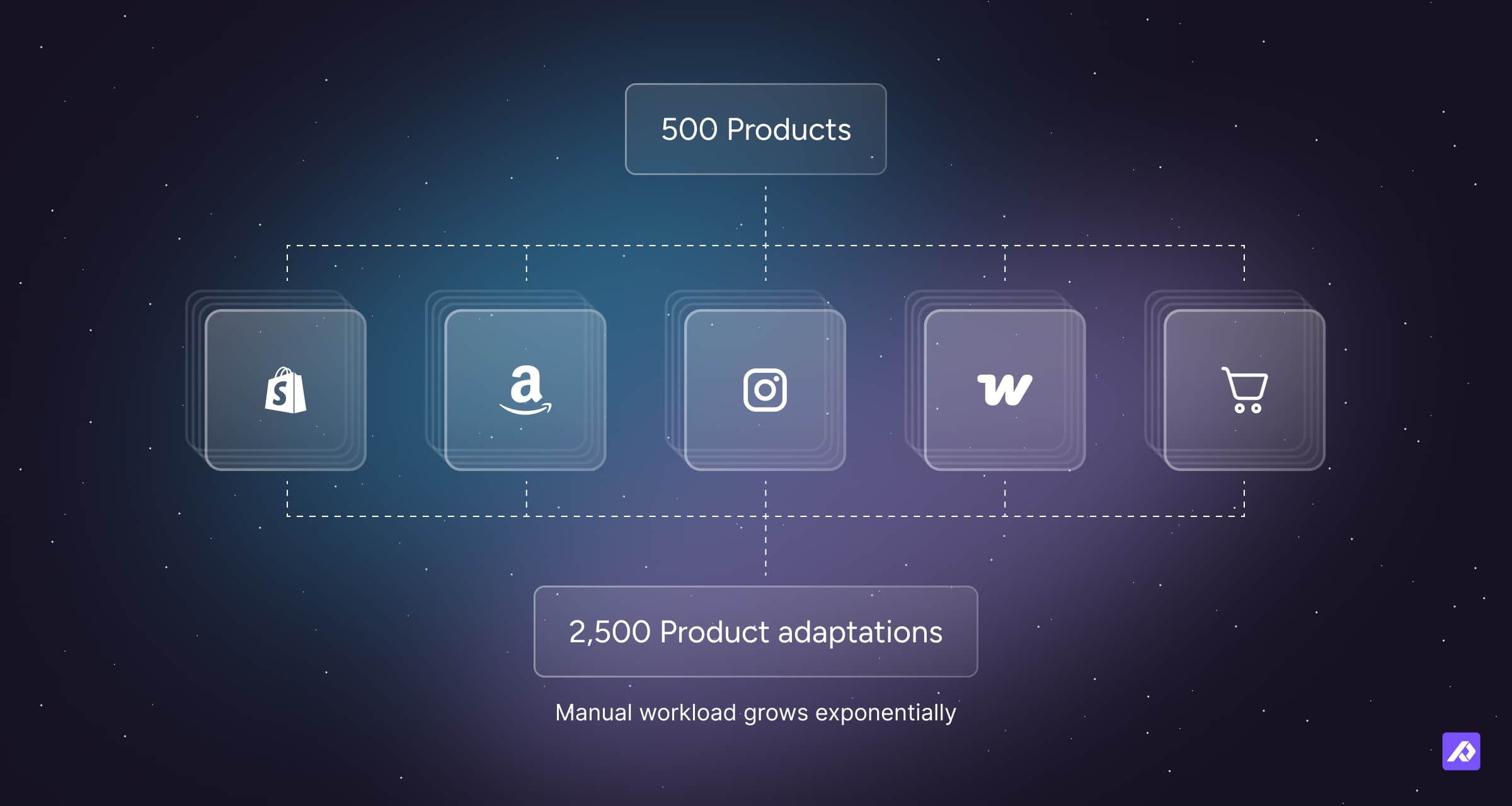
A simple example: if you manage 500 products across Shopify, Amazon, and wholesale, you are not really managing one tidy catalog anymore. You are managing thousands of channel adaptations, each with its own requirements, formatting, and risk of inconsistency.
That is the point where manual processes usually start to break.
If this is happening, a PIM is probably overdue
| What you are seeing | What it usually means |
|---|---|
| Product data lives across spreadsheets, supplier files, and shared drives | Your product content has outgrown manual management |
| Different teams use different versions of the same product details | You do not have one reliable operating system for product content |
| Launching a new product takes too long | Content is scattered and approvals are slow |
| Updating multiple channels feels chaotic | Your process does not scale across destinations |
| Variants, localization, or compliance are getting harder to manage | Product complexity is increasing faster than your tools can handle |
| Your team spends more time finding information than using it | The workflow is broken, not just the storage |
You probably need a PIM if:
- you sell across multiple channels or markets
- your catalog is growing in size or complexity
- several teams touch the same product information
- spreadsheets are becoming your main operating system
- product launches depend on manual follow-up
- channel requirements keep forcing extra work
If product information still feels simple and stable, you may not need a PIM yet. If it feels fragile, inconsistent, or slow, you probably do.
What information can you store in a PIM?
A PIM is designed to store the information that defines, describes, supports, or sells your products.
That usually includes:
Product content
Names, titles, descriptions, feature bullets, and marketing copy.
Product specifications
Dimensions, materials, ingredients, weight, technical details, compatibility data, and regulatory fields.
Digital assets
Images, videos, 3D files, diagrams, and any other media associated with a product.
Documents
Manuals, safety sheets, certificates, installation guides, warranty information, and price lists.
Channel-specific content
Different versions of product information for ecommerce sites, marketplaces, retailer portals, catalogs, or regional teams.
Localization data
Translations, local naming conventions, region-specific claims, and market-specific attributes.
Why is Product Information Management important?
Product Information Management matters because product information gets complicated faster than most companies expect.
A small catalog with one channel and one team can survive on spreadsheets for a while. Add more SKUs, more variants, more people, more channels, or more markets, and the cracks show quickly.
Without PIM, companies often run into the same problems:
- inconsistent product information across channels
- missing or outdated data
- slow product launches
- duplicate manual work
- approval bottlenecks
- difficulty managing variants and localization
- poor visibility into which version is correct
- channel errors that hurt the customer experience
The cost is not just operational. Poor product information slows launches, weakens channel performance, and makes expansion harder than it should be.
What is the strategic outcome of using a PIM?
The immediate job of a PIM is to organize product data. The bigger outcome is that it helps businesses use product content more effectively across the business.
When product content is scattered or hard to maintain, teams repeat work, channel errors increase, and launches take longer. A PIM helps fix that by turning product content into something structured, dependable, and ready to scale.
That usually leads to four business outcomes:
Faster time to market
Products move from raw data to channel-ready content much faster.
Better conversion
Richer, clearer, more accurate product content gives shoppers better information before they buy.
Lower operational drag
Teams spend less time fixing, copying, chasing, and reformatting the same information.
Easier expansion
New channels, retailers, and markets become easier to support because the content foundation is already in place.
What teams typically work in a PIM?
A PIM is rarely used by just one team. Product information touches too many parts of the business for that.
Marketing teams
They use PIM to create and enrich product content faster and keep messaging consistent.
Ecommerce teams
They use PIM to keep product pages, marketplaces, and feeds accurate and up to date.
Sales teams
They rely on PIM for fast access to current specs, assets, and product collateral.
Product teams
They maintain technical details, specifications, and product structures.
Operations teams
They help connect PIM with other systems and keep workflows running smoothly.
Compliance teams
They use PIM to keep certificates, safety documents, and regulatory information attached to the right products.
What companies typically use a PIM?
PIM is relevant for any company that manages physical products and needs accurate information across multiple systems or channels.
That often includes:
Brands and manufacturers
They need one place to manage product data and share it consistently with retailers, distributors, and sales channels.
Distributors
They receive product information from many brands in different formats and need to standardize and enrich it at scale.
Retailers
They need to centralize product data from multiple suppliers before publishing it to stores, marketplaces, and catalogs.
PIM is especially common in industries where product information is more complex, more variant-heavy, more technical, or more regulated, such as apparel, electronics, food and beverage, beauty, furniture, sporting goods, industrial products, automotive parts, and healthcare products.
How does a PIM fit into your tech stack?
PIM usually sits between your internal source systems and your sales channels.
Upstream systems
A PIM receives data from ERPs, PLMs, supplier files, WMS platforms, spreadsheets, and APIs.
Downstream channels
Once enriched, the product content is sent to ecommerce platforms, marketplaces, retail partners, print catalogs, product feeds, and internal sales materials.
The role PIM plays
A PIM does not replace every other tool. It connects them and gives product information a clear operational home.
What are the benefits of a PIM?
The first benefits of PIM are operational. The bigger benefits are commercial.
A PIM helps teams with:
Centralized information
Product data, specs, assets, and documents live in one structured platform.
Faster content creation
Teams can enrich, update, and publish product content more efficiently.
Better data accuracy
Product information stays more consistent across channels and systems.
Improved collaboration
Teams can work together with more clarity around ownership, approvals, and updates.
Easier compliance
Documents and required product information stay attached to the right products.
Better partner and customer experiences
Retail partners, distributors, internal teams, and customers all get more reliable information.
Scalability
As your catalog, channels, and markets grow, the process stays more manageable.
How does AI support PIM?
AI is becoming more useful inside PIM, especially for teams managing large or fast-moving catalogs.
Common use cases include:
- generating product titles and descriptions
- suggesting missing attribute values
- supporting translations
- identifying content gaps
- speeding up repetitive enrichment work
The practical benefit is not that AI replaces product teams. It is that AI reduces low-value manual work and gives teams more time to improve content quality.
What should you look for when evaluating a PIM?
If you are moving from learning about PIM to evaluating software, focus on whether the system helps your team work better, not just whether the feature list looks impressive.
Look for:
- a clear product model for attributes, variants, and relationships
- strong search, filtering, and bulk editing
- clean workflows for enrichment and approvals
- practical distribution options for your channels
- integrations with your current systems
- a setup your team can actually adopt
A PIM should not just hold product information. It should help your team launch faster, keep channels aligned, and scale product content without constant rework.
Final Thought
Product Information Management is how modern commerce teams make product content perform at scale.
At the surface level, PIM centralizes, enriches, and distributes product information. At the more important level, it gives businesses the system they need to turn product content into a growth asset.
That matters because product content should do more than describe products. It should help products launch faster, convert better, reduce confusion before purchase, and support expansion across channels and markets.
If your team spends more time chasing product information than using it to move the business forward, the problem is no longer just storage. It is the system behind it.
Frequently Asked Questions
PIM stands for Product Information Management.
Product Information Management software is a system that helps companies collect, organize, enrich, manage, and distribute product information from one central place.
The purpose of a PIM is to make product information accurate, complete, and easy to publish across sales and marketing channels.
Companies use PIM because managing product information across spreadsheets, systems, teams, and channels becomes slow and error-prone. PIM gives them one structured process and one shared workspace.
A company should invest in a PIM when product launches are slow, product information is inconsistent, multiple teams are updating the same data, or multichannel selling makes spreadsheets too hard to maintain.
No, PIM is not the same as ERP. ERP manages operational business data, while PIM focuses on the product information needed for commerce and marketing.
No, PIM is not the same as DAM. DAM manages files and media assets, while PIM manages the broader product content structure around those assets.
No, PIM is not only for ecommerce. It is especially useful for ecommerce, but brands, manufacturers, distributors, and retailers also use PIM to manage product information across catalogs, partners, sales teams, and other channels.
Yes, PIM can help with variants and localization by giving teams one place to manage shared attributes, variant-specific details, and market-specific content.
Yes, PIM can be worth it for a small team if that team is already struggling with product complexity. The trigger is not company size. The trigger is whether product information has become too fragile, too scattered, or too manual to manage well.
If you do not have a PIM, product information usually ends up spread across too many tools and too many people. That leads to errors, slower launches, duplicated work, and weaker consistency across channels.
PIM helps with channel expansion by giving teams one structured content foundation that can be adapted for different marketplaces, retailers, regions, and sales channels without rebuilding product information from scratch each time.
PIM can help improve ecommerce conversion by making product content clearer, richer, and more consistent. Better titles, descriptions, specs, images, and attributes help shoppers understand products and buy with more confidence.
PIM can help reduce returns by making product information more accurate before purchase. Clearer dimensions, materials, compatibility notes, usage details, and images help set better expectations.
PIM is different from a feed management tool because PIM manages the core product content itself, while feed tools mainly format and distribute that content to channels.
The difference between PIM and PXM is that PIM focuses on managing and structuring product information, while PXM focuses more on optimizing the product experience across channels. In practice, PIM is often the foundation that makes PXM possible.