
PIM vs ERP: What’s the Difference?
The difference between PIM and ERP is that ERP manages operational business data like inventory, orders, and pricing, while PIM manages the customer-facing product information needed to sell across channels.
TL;DR
- ERP manages operational data like stock, orders, and pricing.
- PIM manages customer-facing product content like descriptions, images, attributes, and channel-ready details.
- Early-stage companies often stretch one system to do both jobs.
- Growing companies usually need both because an ERP protects data accuracy, while a PIM makes that data usable for customers.
- ERP runs the broader business, while PIM focuses on the product information needed to list, localize, and optimize products across channels.
ERP vs PIM at a glance
| System | ERP | PIM |
|---|---|---|
| Primary Goal | Operational accuracy | Sales performance |
| Data Type | Operational (Stock, Price, Cost) | Customer-facing (Descriptions, Specs, Media) |
| What triggers change | Real-world events (Orders, Stock movement) | Market needs (New channels, seasonal updates) |
| Primary Users | Operations, Finance, Supply Chain | Ecommerce, Marketing, Brand Managers |
| Where data goes | Internal (Reporting, Fulfillment) | Customer-facing (Websites, Marketplaces, Apps) |
| The "Pain" it solves | "We don't know how much we have." | "It takes us 3 weeks to list a new product." |
What each system is built to do
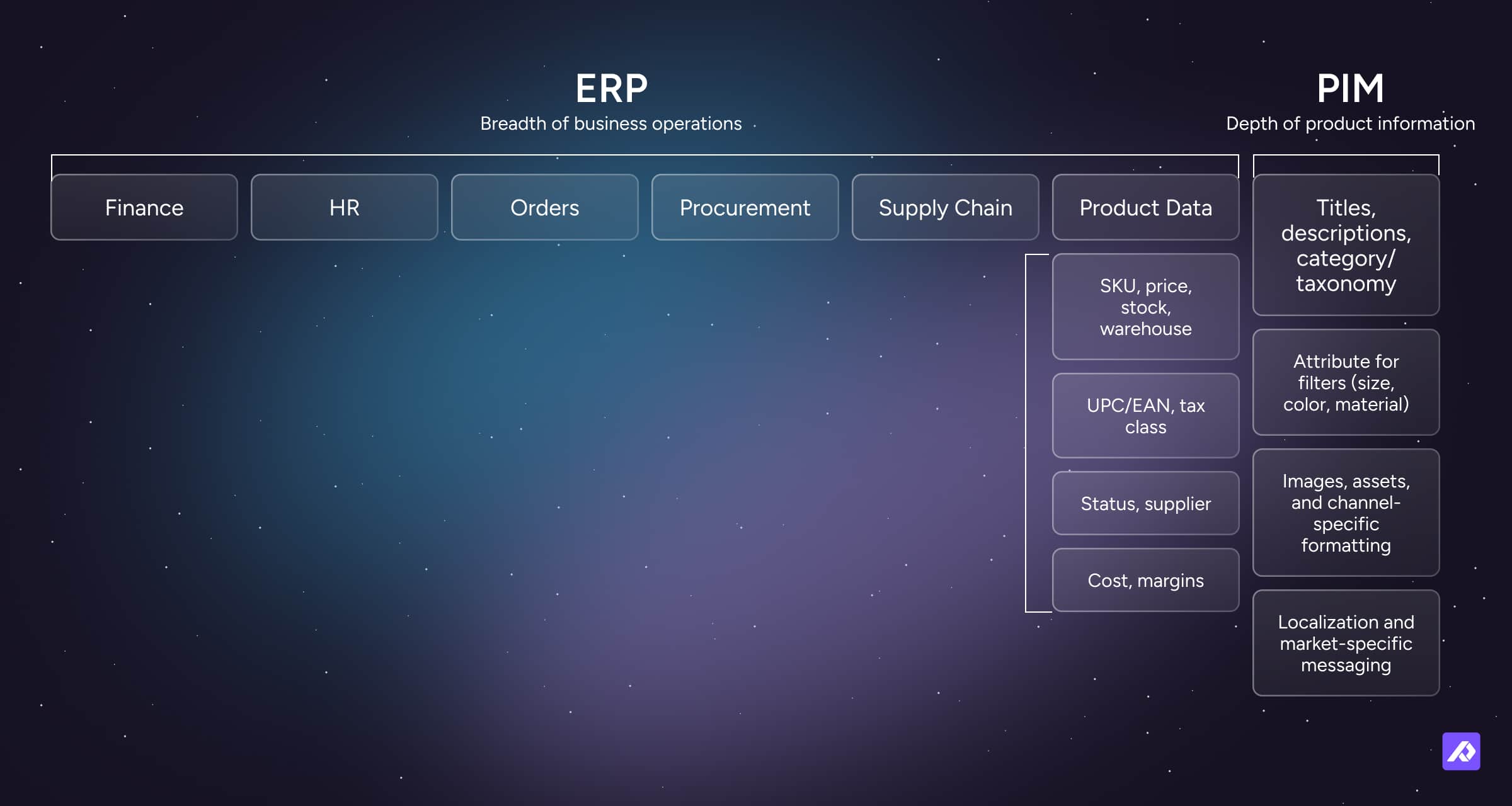
ERP and PIM are designed to solve fundamentally different problems, even though both deal with product data.
An ERP exists to keep the business running correctly. It handles everything from payroll and finance to inventory and shipping. When it comes to product data itself, ERP systems usually handle a small set of core fields.
The ERP asks: Is this SKU in stock? What is the cost? Where is it in the warehouse? It’s designed for stability and audit trails.
A PIM exists to get products ready to sell. It goes deep on product information so customers see the right details in the right place. That includes attributes that power search-friendly titles, technical specs, high-res images, and translations of product content adapted for each channel or market.
The PIM asks: Does this description make sense on Amazon? Do we have the right photos for the mobile app? Is the size guide accurate for the French market?
The difference shows up as soon as the same product needs to appear in more than one place. The ERP confirms you have a product to sell. The PIM makes sure someone actually buys it.
What data ERP and PIM handle best
The simplest distinction is that ERP manages operational product data, while PIM manages market driven product data.
ERP data is operational and system-driven.
ERP data only changes when something happens in the real world, like:
- a shipment arrives
- a customer buys an item
- a supplier raises their price
This data must be stable and trusted by your finance team.
However, ERP data usually covers only a small share of what you need to sell effectively online. A SKU and a price aren't enough for modern ecommerce platforms and marketplaces.
The remaining product data, like attributes, taxonomy, images, and channel-specific requirements, typically lives outside the ERP.
PIM data is contextual and market-driven.
PIM data changes based on where you sell, who you are selling to, and what each channel requires. For example:
- a product title that works on your website might be too long for a Google Shopping ad
- a technical measurement needs to be converted from inches to centimeters for Europe
This data exists to help a customer find, compare, and trust a product.
This is why ERP data is usually tightly controlled, while PIM data is intentionally flexible. The two systems optimize for different outcomes.
Similarities and key differences between ERP and PIM
ERP and PIM are often discussed as opposing systems, but they do share some common ground.
Both systems help reduce inconsistency and manual work, but they usually play different roles. ERP is typically the system of record for operational product data, while PIM is the place where that product data is enriched and prepared for customers and channels.
The difference is how much each system covers and what it is optimized for.
| Feature | ERP | PIM |
|---|---|---|
| Focus / scope | Spans many parts of the business and handles a limited set of product fields for operational accuracy | Focuses entirely on product information and goes deep on the content needed to sell across channels |
| Change triggers | Real-world events like orders, stock movement, and price changes | Market needs like new channels, regions, content updates, and localization |
| Core strength | Stability, control, auditability | Flexibility, enrichment, channel readiness |
This difference in focus is why the two systems are usually used together rather than in place of one another.
What does this look like in real life?
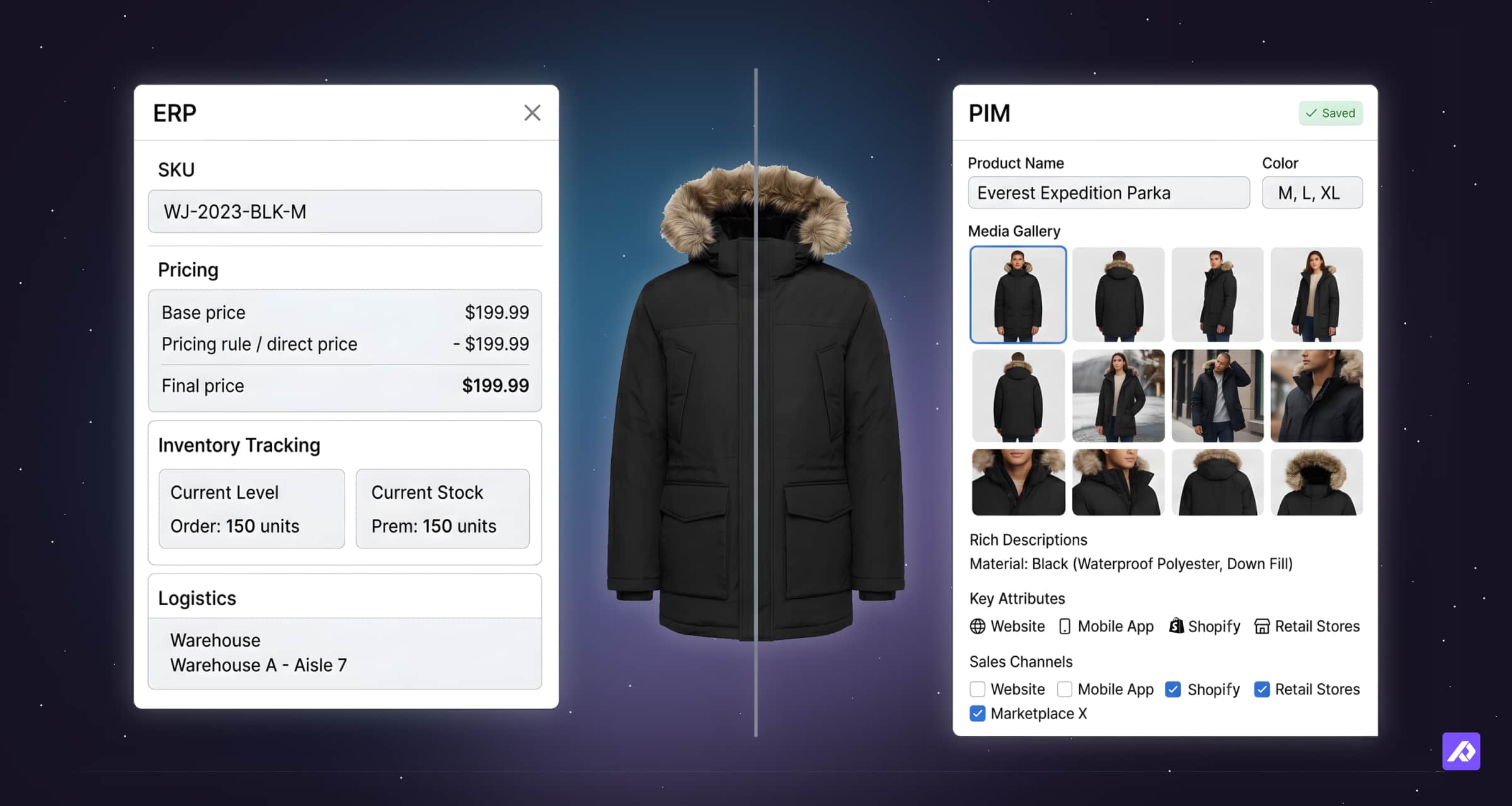
Here’s a simple example using the same product in both systems:
Imagine you sell a winter jacket.
In the ERP, that jacket needs:
- SKU: WJ-2023-BLK-M
- Wholesale Cost: $110.00
- Retail Price: $249.99
- Inventory: 142 units
- Warehouse: Aisle 4, Bin 12
In the PIM, that same jacket needs:
- Product Name: Everest Series Men’s Down Jacket
- Feature Bullets: 800-fill power, waterproof ripstop shell, detachable faux-fur hood.
- Media: 6 high-res studio shots, 1 lifestyle video, 1 technical size chart.
- Localization: Professional German translation and metric measurements.
- Channels: Formatted specifically for Shopify and Amazon requirements.
If the ERP data is wrong, you lose money or ship the wrong item. If the PIM data is wrong, the customer never finds the jacket in the first place or they return it because the description didn't match the product.
Same product. Very different jobs.
Choosing between ERP-only and ERP + PIM
Most teams don't start out with the "wrong" system; they just reach a point where their ERP is being asked to do too much. You know you’ve reached that limit when your marketing team is working out of spreadsheets because the ERP is "too difficult" or "doesn't have a place for images."
Quick checklist: Is ERP-only still sustainable?
| Check | ERP-only is fine if... | You need a PIM if... |
|---|---|---|
| Catalog Size | Your catalog is small and rarely changes. | You’re launching new products or variants constantly. |
| Channels | You sell in one place (for example, just your B2B portal). | You sell on your site, Amazon, and through retail partners. |
| Content | A SKU and a basic name are enough to sell. | You need rich descriptions, videos, and complex filters. |
| Localization | You sell in one language and one currency. | You need to manage multiple languages and regions. |
| Team | One person handles all product data. | Multiple teams (Marketing, Sales, Product) need to collaborate. |
Decision shortcut:
- Choose ERP-only when your main headache is operational accuracy.
- Choose ERP + PIM when your main headache is getting products listed, enriched, and ready for customers across channels.
How ERP and PIM work together
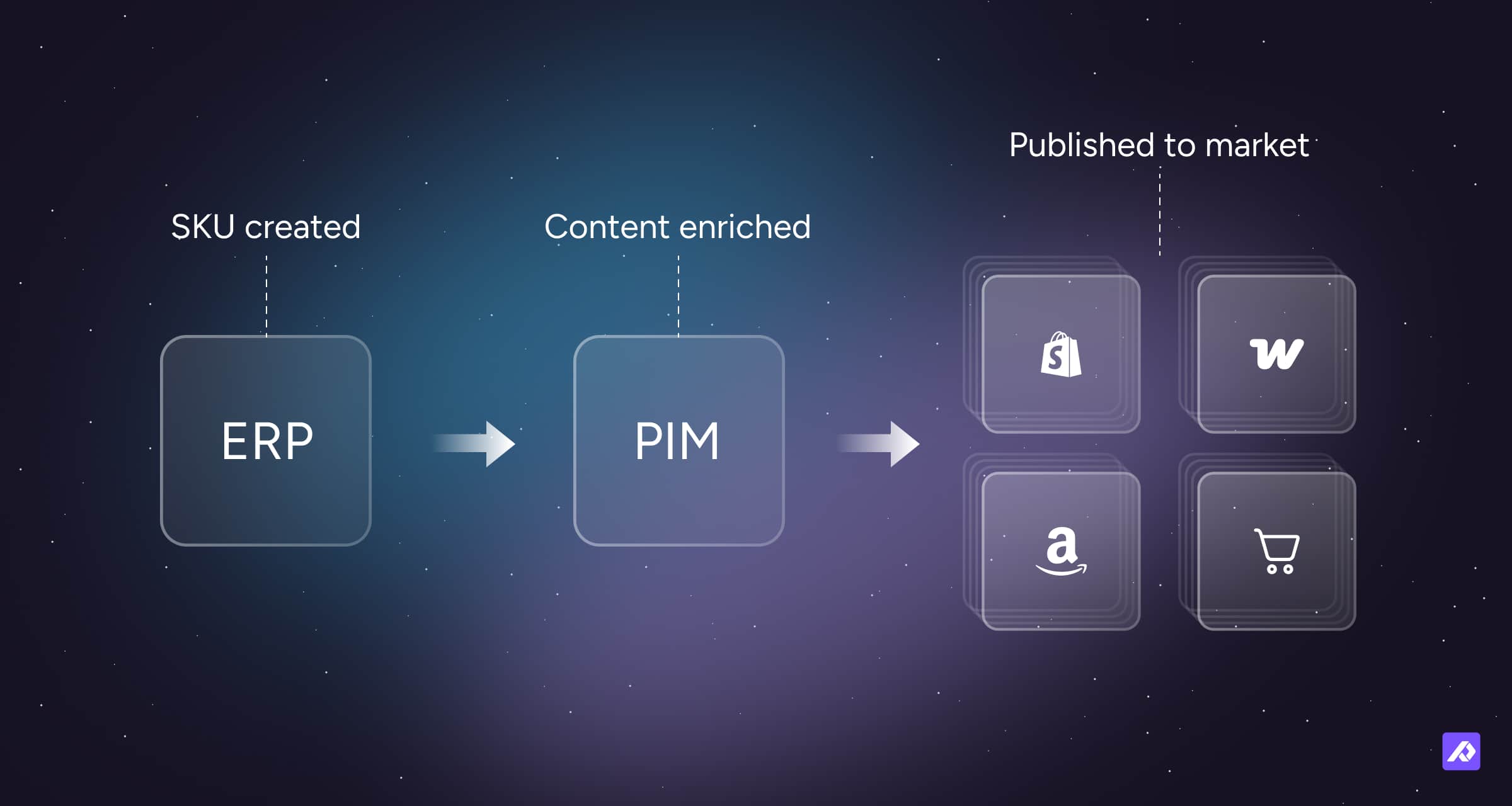
As companies scale, ERP and PIM usually take on clear, complementary roles. This is commonly referred to as an ERP + PIM architecture, where ERP remains the system of record and PIM becomes the system of context.
In a healthy "ERP + PIM" architecture, the two systems stay in their lanes.
- The SKU is born in the ERP: Operations creates the record, sets the price, and assigns a warehouse location.
- The SKU is enriched in the PIM: Marketing sees the new SKU, adds the descriptions, uploads the photos, and optimizes it for SEO.
- The Product is published: The PIM sends the finished, "customer-ready" data to your website and marketplaces.
This separation means your finance team doesn't have to worry about marketing images breaking their reports, and your marketing team doesn't have to wait for "system access" just to fix a typo in a product description.
Final Thought
Understanding the difference between PIM and ERP is less about software categories and more about separating operational truth from commercial context.
When you stop trying to force marketing descriptions into an operations tool, your team works faster, your data stays cleaner, and your customers get the information they need to buy with confidence.
Frequently Asked Questions
No, a PIM cannot replace an ERP. A PIM does not manage transactions, inventory movements, purchasing, or financial operations. It works alongside an ERP by taking operational product data and turning it into customer-facing product content for websites, marketplaces, and other sales channels.
Sometimes PIM is offered as part of an ERP, but it is usually limited compared with a dedicated PIM. ERP product modules are often built for operational control, while a standalone PIM is built for richer product content, multichannel formatting, and the day-to-day needs of ecommerce and marketing teams.
In most businesses, ERP comes first and PIM is added later. That usually happens when product content becomes too complex to manage inside the ERP alone. In ecommerce-heavy businesses, though, PIM can become urgent earlier if listings, variants, assets, and channel requirements start slowing the team down.
ERP is usually owned by operations, finance, or supply chain teams, while PIM is usually owned by ecommerce, marketing, product, or content teams. That split reflects what each system is built to do: ERP protects operational accuracy, while PIM helps teams prepare and publish product content effectively.
The data typically synced between ERP and PIM includes core operational fields like SKU, price, stock, supplier, and status. The PIM then adds enriched product content such as descriptions, attributes, images, translations, and channel-specific formatting before sending that finished content to sales channels.