
PIM Implementation Paths 2026: DIY, Vendor-Led or Partner-Led?
TL;DR
- There are three main PIM implementation paths: DIY, vendor-led, and partner-led.
- DIY PIM implementation works best for smaller, cleaner setups with a clear internal owner.
- Vendor-led implementation works best when you want guided onboarding from people who know the platform inside out.
- Partner-led implementation works best for more complex environments, especially when integrations, migration, or multi-market setup are involved.
- These represent the main PIM rollout options available to teams in 2026.
- The best path depends on your catalog complexity, internal capacity, timeline, and tolerance for risk.
- In 2026, this decision matters more because product data now supports AI workflows, faster channel expansion, and growing compliance demands.
What is a PIM implementation?
A PIM implementation is the process of setting up how your product information is structured, connected, and managed inside a Product Information Management system.
That includes more than just importing a spreadsheet.
A real implementation usually involves:
- defining your product structure, such as categories, families, variants, and attributes
- cleaning and mapping existing product data
- deciding how the PIM connects to other systems
- setting up workflows for enrichment, review, and approval
- configuring outputs for ecommerce channels, marketplaces, retailers, or internal teams
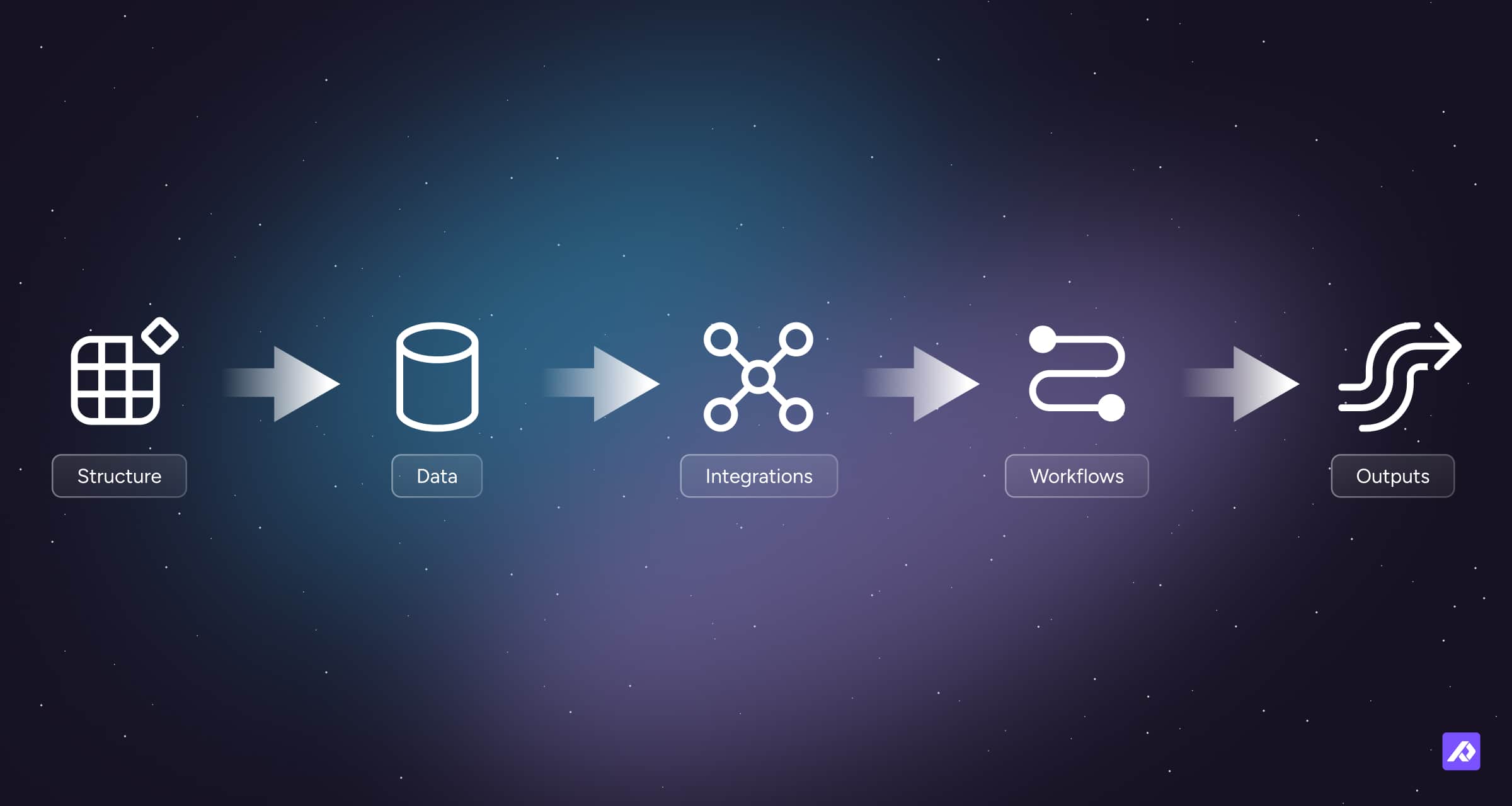
In plain English, implementation is the part where you decide how your product data will actually work once the PIM is live.
Why implementation path matters
Most PIM projects do not get stuck because of the software. They get stuck because the data, decisions, and ownership were messier than expected.
That is why the implementation path matters.
The path you choose affects four things right away:
- Speed: how quickly you get to a useful first version
- Control: how much your internal team owns and designs directly
- Cost: what you spend upfront in time, services, or both
- Risk: how likely you are to create rework, confusion, or long-term maintenance problems
This is not really a question of which path is best in general. It is a question of which path fits your actual setup.
A simple catalog with one ecommerce channel is one kind of project. A multi-market business with ERP dependencies, supplier chaos, and custom workflows is another.
The 3 main PIM implementation paths
There are three common PIM implementation paths, each representing a different implementation model selection depending on your needs.
DIY PIM implementation
Your internal team sets up the system using documentation, templates, support resources, and your own time.

Vendor-led implementation
The PIM provider guides the rollout through onboarding, setup support, and platform best practices.

Partner-led implementation
A third-party implementation partner helps design and execute the setup, often with added support for integrations, migration, and process design.

Each path can work. The question is when.
Comparison: At a glance
The table below compares the main PIM rollout options across timeline, cost, and control.
| Path | Typical Timeline | Relative Cost | Control | Best For | Main Risk |
|---|---|---|---|---|---|
| DIY | 6 to 12 weeks | Low | High | Smaller catalogs, fewer integrations, strong internal owner | Rework caused by weak data modeling or unclear ownership |
| Vendor-led | 4 to 10 weeks | Medium | Medium | Teams that want structured onboarding and faster time-to-value | Staying too close to the standard model when the setup needs more tailoring |
| Partner-led | 6 to 16 weeks for focused projects, longer for broader transformations | High | Medium | Complex migrations, custom integrations, large catalogs, multi-market setups | Choosing a generalist partner without deep experience in your specific platform |
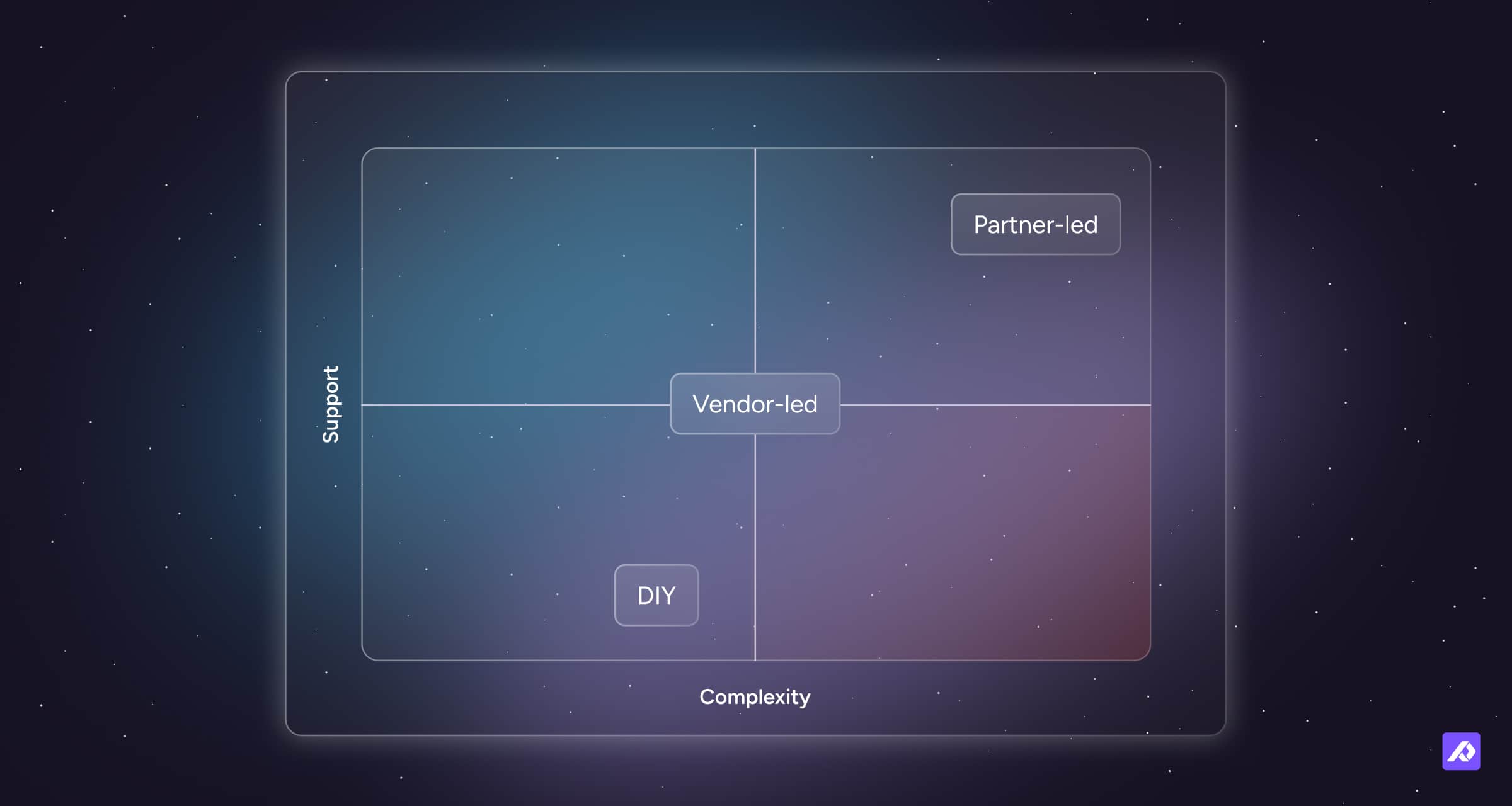
The key thing to notice is this: complexity drives timeline more than the label on the path does.
A strong partner can speed up a difficult project. A DIY project can drag on for months if the data model is shaky and decisions keep changing.
Where implementations usually get difficult
Most teams do not struggle because the PIM itself is hard to use. They struggle because implementation reveals problems that were already there.
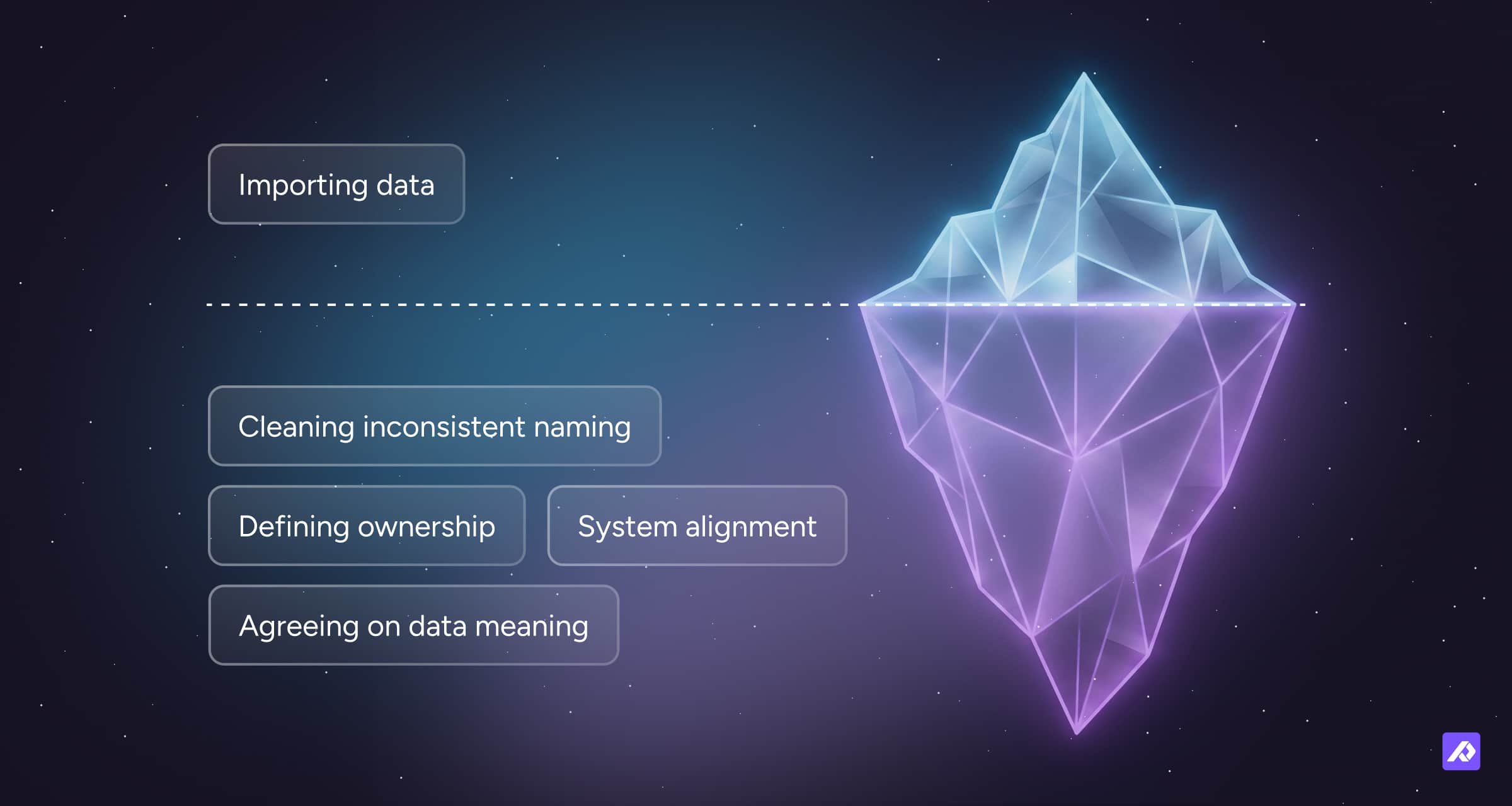
Common examples include:
- Data that looks tidy, but is not: spreadsheets often hide duplicates, inconsistent naming, missing values, and mixed logic
- Systems that define things differently: the ERP, ecommerce platform, supplier files, and internal naming conventions rarely line up cleanly
- Unclear ownership: nobody is fully responsible for structure, governance, or final decisions
- Underestimated iteration: teams assume implementation is one setup phase, when it is really a cycle of testing, learning, and adjusting
- Overconfidence early on: people assume the hard part is importing the data, when the real work is agreeing on what the data should mean
This is why implementation is part technical project, part operating model design.
Roles and responsibilities in a PIM implementation
No matter which path you choose, internal ownership still matters.
A successful PIM rollout usually needs these roles covered:
- PIM or Product Data Owner: defines the structure, standards, and long-term governance
- Business stakeholders: explain what sales, ecommerce, marketing, and operations actually need from the data
- Technical owner or integrations lead: handles system connections, imports, exports, and technical constraints
- Project manager: keeps decisions, timelines, and responsibilities moving
Even if a vendor or partner does a lot of the heavy lifting, your team still needs to decide how the business wants product data to work.
The DIY path
DIY means your internal team handles the implementation using the tools, documentation, and support resources provided.
This path works best when:
- you have a clear internal owner with real time to lead the project
- your catalog is relatively simple
- your data is already fairly clean and structured
- your integrations are standard or limited in number
- your team is comfortable making decisions about product structure and governance
For many teams, DIY is most realistic when the catalog is under about 1,000 SKUs, the channel mix is manageable, and the business is not trying to untangle years of messy legacy processes at the same time.
Pros of DIY
- lower upfront cost
- more direct control over setup and pace
- stronger internal understanding of the system from day one
- easier to adjust priorities without waiting on an outside team
Risks of DIY
- internal teams often underestimate how much cleanup and mapping is needed
- no outside pressure means decisions can drift or stall
- the first version may reflect current chaos instead of a cleaner future structure
- teams can spend months solving avoidable problems the hard way
DIY is often treated like the cheap path. Sometimes it is. Sometimes it is just the path where you pay later through rework.
That is why data readiness matters so much here. If you go DIY, audit your data first. Do not assume a successful export means the structure is implementation-ready.
The vendor-led path
Vendor-led implementation means you work directly with the PIM provider’s onboarding or implementation team.
This is usually the best fit when:
- you want a faster, more structured rollout
- your team wants guidance from people who know the product deeply
- you do not need a heavily customized setup on day one
- you want help building a solid first version without inventing the process from scratch
Vendor-led projects often strike the middle ground between control and support.
You still make the key business decisions, but the provider helps you avoid obvious mistakes, follow platform best practices, and move toward a usable setup faster.
Pros of vendor-led
- guided onboarding from people who know the platform best
- clearer milestones and a more predictable rollout
- faster time-to-value for standard or moderately complex setups
- less risk of building the wrong thing in the first phase
Risks of vendor-led
- the setup may lean toward the platform’s standard model, even when your case needs extra tailoring
- vendor services may stop short of broader system design or deep custom integration work
- internal teams may expect the vendor to own decisions that still need internal alignment
In 2026, many vendors also use AI-assisted mapping, import support, and smarter setup workflows to speed up the early phases. That can save time, but it does not replace the need for clear internal ownership.
The partner-led path
Partner-led implementation means you bring in a third-party specialist to help design and execute the rollout.
This path tends to make the most sense when:
- your data model is complex
- you have custom integrations or API-heavy needs
- multiple markets, languages, or business units are involved
- migration and cleanup are a serious project in their own right
- your team needs more hands-on execution support than the vendor typically provides
The biggest misconception here is that partner-led always means slow.
It can be the longest path when the project itself is broad and complicated. But for a high-complexity setup, the right partner can actually be the fastest route to a stable result because they reduce bad decisions, prevent structural drift, and handle technical complexity early.
Pros of partner-led
- strong support for complex migrations and integration work
- outside expertise in data modeling, governance, and rollout planning
- more capacity to handle execution, not just guidance
- lower risk of long-term structural mistakes
Risks of partner-led
- higher upfront cost
- quality varies a lot from partner to partner
- a generic consultancy may know digital transformation in theory but not your platform in practice
- too many voices can create delays if roles and decision rights are not clear
A good rule of thumb: if you choose a partner, look for one that is recommended by the vendor, certified in that platform, or clearly experienced with that specific ecosystem.
That is very different from hiring a broad consultancy that says it has worked with all kinds of PIMs.
The best partner is usually not the one with the broadest pitch. It is the one that already knows where the common mistakes happen in your chosen platform and how to avoid them.
How to choose the right path
Choosing between these PIM implementation paths is really based on your complexity and internal capacity.
Here is a practical way to think about it.
Choose DIY when:
- your catalog is manageable
- your internal owner is clear
- your data is reasonably structured
- your integrations are straightforward
- your team can dedicate real time to the project
Choose vendor-led when:
- you want guidance without handing the whole project to a third party
- you want a faster path to a solid first version
- your setup is standard to moderately complex
- your team wants to learn the platform while implementing it
Choose partner-led when:
- you are connecting to custom or legacy systems
- you need help with migration, cleanup, or governance design
- your catalog spans multiple markets, channels, or languages
- the cost of getting the structure wrong is high
A simple self-check helps too:
- Do we have a real internal project owner with time to lead this?
- Is our data already fairly clean and consistent?
- Are our integrations standard enough that we understand them clearly?
- Can we make structural decisions quickly without endless internal debate?
If the answer is yes across the board, DIY may be enough.
If several answers are shaky, vendor-led or partner-led support is usually money well spent.
Choosing with 2026 realities in mind
Implementation path decisions carry more weight in 2026 than they did a few years ago.
That is because product data now powers more than ecommerce listings.
It also supports:
- AI-assisted content creation and enrichment
- expansion into more channels and marketplaces
- market-specific content and localization
- growing compliance expectations around transparency and sustainability
This changes the decision in three important ways.
1. AI can accelerate setup, but not replace structure
AI-assisted mapping, attribute extraction, and cleanup can help teams move faster.
But AI is only useful when there is a clear model underneath it. It cannot fix fuzzy ownership or a weak taxonomy by itself.
2. Compliance raises the cost of messy data
As sustainability and traceability requirements expand, product data needs to be more complete, more consistent, and easier to prove.
That makes implementation quality more important, not less.
3. Composable stacks reward good planning
Modern commerce setups are more flexible than before. They are also easier to make messy.
If your stack includes multiple content, commerce, and operations tools, the value of getting the data foundation right goes up fast.
Implementation readiness checklist
Before choosing a path, check your readiness in four areas.
Data readiness
- product data can be exported from current systems
- categories, families, or product groupings are at least partly defined
- key attributes have been identified
- the biggest data quality issues are understood
People and ownership
- a clear PIM owner is assigned
- business stakeholders are identified
- technical responsibility is assigned
- internal time has been reserved for the project
Systems and integrations
- source and destination systems are known
- the integration approach is understood at a basic level
- platform constraints and technical dependencies are documented
Goals and success criteria
- the business knows what success looks like
- launch priorities are clear
- the team agrees on what the first useful version needs to include
You do not need perfect readiness. But you do need enough clarity to avoid turning implementation into an expensive guessing exercise.
The Plytix advantage: support options that fit your setup
With Plytix, you are not forced into a single implementation model.
That matters because not every business needs the same level of support.
DIY with guidance
Teams that want to move independently can still get support from a dedicated Customer Success Manager, plus best-practice guidance and help when questions come up.
Vendor-led onboarding
Teams that want a more structured rollout can work with Plytix onboarding specialists who help shape the setup, guide key decisions, and keep momentum moving.
Partner-led support
For businesses with more advanced requirements, the Plytix Partner Network can support integrations, migration work, technical development, and more managed implementation help.
The point is not to push everyone into the same path.
The point is to match the level of support to the level of complexity.
Final Thought
The best PIM implementation path is the one that matches your real level of complexity, not the version of the project you wish you had.
If your catalog is small, your data is clean, and one person can own the rollout, DIY may be enough.
If you want faster guidance and a safer route to a working setup, vendor-led is often the sweet spot.
If your project involves messy source data, custom integrations, multiple markets, or high stakes for getting the structure right, a platform-specific partner can save time by preventing the kind of rework that slows teams down later.
In other words, the implementation path is not really a question of who does the work. It is a question of how much complexity you are trying to absorb on your own.
Frequently Asked Questions
Yes. Many teams do exactly that.
A common pattern is to start with a simpler setup, then bring in extra help later for scaling, optimization, migration, or more advanced integrations.
That said, if your data model is already complex, bringing in help earlier is usually cheaper than rebuilding the structure later.
Not always.
For standard setups, business users can often lead much of the implementation, especially with vendor guidance.
Technical support becomes more important when the project includes custom integrations, API work, or complicated data transformation.
For a simpler setup, a first useful version can often be live within a few weeks.
More complex implementations can take several months.
The biggest variable is usually not the software. It is the amount of cleanup, mapping, and internal decision-making needed around the data.
The most common causes are unstructured data, unclear ownership, underestimated integration work, and slow decisions about taxonomy or attribute logic.
Projects slow down when teams discover complexity late instead of naming it early.
The biggest risk is underestimating how much structure and decision-making the project requires.
Most rework does not come from the tool. It comes from weak data modeling, fuzzy ownership, and trying to move too fast without agreeing on how the system should work.